AutoBrush Review 2026: Does the Sonic Pro Really Work in 30 Seconds?
-
September 01 , 2026
-
38
Quick Verdict:
| Our Assessment | |
| Overall Rating | 8.7/10 |
| Best For | People who struggle with conventional brushing technique, time, dexterity or brushing compliance; especially families and some children |
| Current Standout Product | Sonic Pro |
| Pros | ADA Accepted, U-shaped nylon head, 30/60/90-second timers, three cleaning modes, multiple sizes, kids version, clinically evaluated design |
| Cons | Higher ongoing head cost, unusual technique requires adjustment, not genuinely hands-free, fit matters, subscription complaints appear in independent reviews |
| Short Summary | AutoBrush is no longer just another viral U-shaped toothbrush. The AutoBrush U-shaped Toothbrush Series has earned the ADA Seal of Acceptance for plaque removal and helping prevent and reduce gingivitis when used as directed. Its biggest advantage is making full-mouth brushing faster and more consistent—but users still have to move it correctly. |
AutoBrush Review 2026: A Shortcut That Actually Cleans?
Thirty seconds sounds suspiciously short for brushing your teeth. That's the first issue any credible AutoBrush review has to address. Conventional dental advice has conditioned most of us to think of brushing as a two-minute process. AutoBrush takes a completely different approach: surround the upper and lower teeth simultaneously with a U-shaped head containing thousands of bristles, vibrate them together, and cover multiple surfaces at once. It sounds brilliant in theory. U-shaped brushes, however, have historically had a credibility problem. Cheap silicone mouthpiece brushes sold online often look similar while having very little in common with a conventional toothbrush's ability to physically disrupt plaque.
AutoBrush has worked hard to separate itself from that category. The most significant development is independent of the company's marketing: the American Dental Association currently lists the AutoBrush U-shaped Toothbrush Series as ADA Accepted. The ADA says its acceptance is based on finding the product safe and effective at removing plaque and helping prevent and reduce gingivitis when used as directed. That materially changes how we assess the product. This isn't proof that AutoBrush is perfect for every mouth, nor does it mean you can put it between your teeth, stand completely still for 30 seconds and expect perfect oral hygiene.
In fact, AutoBrush explicitly says you must guide the brush using side-to-side or figure-eight movement. So, does AutoBrush work?
The answer is more convincing than it used to be. But there are important catches.
Check Today's Price
What Is AutoBrush?
AutoBrush is an oral-care company best known for U-shaped toothbrushes designed to clean many tooth surfaces simultaneously. Its flagship adult model is the Sonic Pro. Instead of the small rectangular or circular head used by Sonicare and Oral-B, AutoBrush uses a double-sided U-shaped nylon-bristle mouthpiece. You place the brush in your mouth, close down gently and guide it using the prescribed movement while the motor vibrates the bristles. The current Sonic Pro includes three cleaning modes, three timer options and red/blue LED modes. The package includes the brush body, double-sided nylon head, charging base, USB cable and charging block.
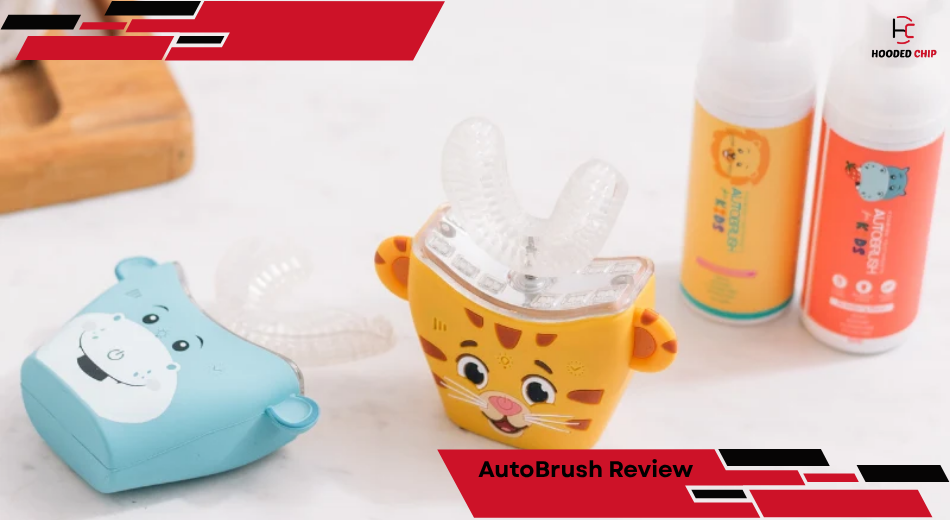
AutoBrush also offers children's models. The Sonic Pro Kids is available in multiple age-specific sizes and character designs. The ADA's 2025 Seal reference guide includes the AutoBrush U-shaped Toothbrush Series among children's toothbrushes as well as powered toothbrushes generally.
That makes the product particularly interesting for families dealing with one of the most common parenting battles: getting children to brush properly and consistently.
AutoBrush Sonic Pro Review: Key Features
The U-Shaped Nylon Brush Head Is the Main Difference
Forget the LEDs and accessories for a moment. The brush head is the reason AutoBrush exists. Its U shape allows bristles to contact multiple teeth and tooth surfaces at the same time. AutoBrush says its models use a tested double-sided nylon brush head with up to 58,000 tapered bristles. Nylon is an important distinction. Many inexpensive U-shaped toothbrushes rely heavily on soft silicone nubs. Those products may resemble AutoBrush visually, but similarity in shape doesn't establish similarity in cleaning performance.
The AutoBrush system physically uses nylon bristles and has undergone the evaluation required for the ADA Seal. According to the ADA—not AutoBrush's advertising—the accepted series has demonstrated safety and efficacy for plaque removal and helping prevent and reduce gingivitis when used as directed. That's the strongest evidence supporting the product.
30 Seconds Doesn't Mean “Put It In and Do Nothing”
This point needs emphasis because it's probably the biggest misconception about AutoBrush.
The current Sonic Pro has:
- Green timer: 30 seconds
- Blue timer: 60 seconds
- Red timer: 90 seconds.
But AutoBrush isn't entirely automatic. The company explicitly says users should hold the device lightly and move the jaw or brush side-to-side or in a figure-eight pattern. Leaving it stationary will not produce a proper clean. That makes sense mechanically. Different mouths have different arch shapes and tooth positions. Motion helps bring the bristles into contact with the gumline, posterior teeth and irregular surfaces. This requirement doesn't undermine AutoBrush. It simply means “30-second toothbrush” is a better description than “hands-free toothbrush.”
Three Cleaning Modes
Sonic Pro currently offers Gentle, Deep Clean and Gum Care/Stimulation modes. These correspond to green, blue and red indicators on the device. Multiple intensities are useful because comfort differs significantly between users. Someone switching from a soft manual brush may find maximum vibration aggressive at first, whereas experienced electric-brush users may prefer the stronger setting. The ability to adjust also matters for children and people with sensory sensitivities.
Multiple Mouthpiece Sizes
Fit is particularly important with a U-shaped toothbrush. A conventional Sonicare or Oral-B head can simply be moved wherever needed. A mouthpiece brush has to correspond reasonably well with the user's dental arch. The current adult Sonic Pro offers Women, Men and Preteen sizing. Kids models have age-based sizes including 3–5, 6–8 and 9–12 on current family-product pages. We'd take the sizing guide seriously. An incorrectly sized mouthpiece could reduce comfort and make it harder for bristles to contact the intended surfaces.
Red and Blue LED Modes
Sonic Pro also includes LED functionality. The current controls describe blue light as intended for whitening support, red light for gum-health support and a dual mode combining the two. This is not the reason we'd buy the brush. The ADA's acceptance statement focuses on plaque removal and helping prevent and reduce gingivitis—not cosmetic whitening claims. Think of LEDs as an additional feature rather than the foundation of AutoBrush's value proposition.
First Impressions: AutoBrush Is Different From a Normal Electric Brush
Sonic Pro looks more like an oral appliance attached to an electric handle than a familiar toothbrush. That's neither good nor bad. But there is a learning curve. You have to choose the correct mouthpiece size, distribute toothpaste across the head, position it correctly and learn the movement. AutoBrush says regular toothpaste can be used, although its own foam toothpaste is designed to distribute more easily through the mouthpiece. If you're using ordinary toothpaste, the company suggests pre-foaming or mixing it with a little water to improve distribution. Once you've learned the routine, the experience becomes much simpler.
- Select your mode.
- Place the mouthpiece correctly.
- Activate the cycle.
- Move it as instructed.
- Rinse.
The important question is whether users will actually do that movement rather than assuming the machine handles everything.
Does AutoBrush Work? Performance & Real-World Analysis
The ADA Seal Matters More Than Influencer Testimonials
AutoBrush makes aggressive performance claims on its website. The company advertises figures including up to 5.1× better whole-mouth cleaning, up to 82% better cleaning in hard-to-reach areas and up to 45% better gingivitis reduction, based on its cited clinical studies. Those are company-presented comparisons and need context. More important for our verdict is the independent ADA acceptance.
The ADA Council on Scientific Affairs states that the AutoBrush U-shaped Toothbrush Series has demonstrated safety and efficacy in removing plaque and helping prevent and reduce gingivitis when used as directed. That doesn't mean the ADA guarantees the marketing headline “5.1× better” for every person. It means the product cleared a substantially more meaningful bar than merely having positive testimonials.
The Biggest Advantage Is Consistency
Traditional toothbrushing has an enormous human-error component. You can own a $300 electric toothbrush and still miss surfaces if you rush. Children may brush only their front teeth. Someone with reduced dexterity can struggle to maintain the correct angle around every tooth. A U-shaped design attempts to reduce this variability by contacting many surfaces simultaneously. That could be especially useful for people who find the mechanics of conventional brushing difficult. AutoBrush itself says the design was developed with children, people with mobility limitations and users with sensory sensitivities in mind. We wouldn't assume that means it will work for every person with a disability or sensory difference. But the underlying use case is compelling.
30 Seconds Can Improve Compliance
There's another advantage that's less clinical but potentially just as important. People don't always brush for the recommended amount of time. Children especially can resist two-minute brushing sessions. A shorter routine that's performed consistently may have behavioral advantages over an excellent conventional brush that someone refuses to use properly. AutoBrush Kids adds character designs and brushing songs to make the process more engaging. The company currently prices the Sonic Pro Kids from around the same level as the adult model. For some families, reducing a twice-daily argument could be worth a lot.
The Gumline Requires Technique
This is where we'd temper the enthusiasm. A recent independent Trustpilot reviewer complained that the brush seemed to clean teeth but didn't adequately clean their gumline and said they developed gingivitis after switching from a conventional electric toothbrush. That's a single customer's experience, not proof of a general problem.
But it highlights something AutoBrush itself acknowledges: movement is required.
If you simply bite down and wait, you're not following the usage instructions. Someone unwilling or unable to learn the correct movement may be better served by a conventional powered toothbrush.
AutoBrush for Kids Review
Kids may actually be the strongest argument for AutoBrush. The Sonic Pro Kids combines the U-shaped brushing concept with age-specific sizing, character designs, songs and a built-in timer. Current sizing includes options for ages 3–5, 6–8 and 9–12. More importantly, AutoBrush isn't merely marketing an adult appliance with cartoon graphics. The ADA's reference guide specifically lists the AutoBrush U-shaped Toothbrush Series in its “Just for Kids” toothbrush category. Independent feedback also shows parents using AutoBrush specifically to improve brushing routines. One August 2026 Trustpilot reviewer said she originally bought the brushes for her children to help them brush better and build better habits, then purchased brushes for herself and her husband.
That's exactly the kind of use case where AutoBrush makes sense. It doesn't replace parental supervision for young children. And a dentist should still assess whether the child's teeth are actually staying clean. But for children who resist conventional brushing, the format could remove a significant barrier.
AutoBrush Pricing & Value
Pricing is where the decision gets more complicated. The adult Sonic Pro currently carries a regular price of $89. During our September 1, 2026 check, AutoBrush was displaying a Labor Day price of $74. The subscription option was also $74 and included a new $25 brush head every two months with free shipping. The adult collection likewise showed Sonic Pro at $74 versus $89 regular pricing. Current bundle pricing included:
| Product | Price Observed* |
| Sonic Pro | $74 sale / $89 regular |
| Sonic Pro Kids | $74 sale / $89 regular |
| Sonic Pro Bundle | $75 |
| Sonic Pro Family Pack | $119 on collection page |
| Brush Head Case | $13 |
| Automatic Tongue Scraper | $13 |
| Refresh Bundle | $45 |
*Observed September 1, 2026. Promotions change.
Don't Ignore Replacement-Head Costs
This is where AutoBrush becomes more expensive than the headline purchase price suggests. AutoBrush recommends replacing its brush head every two months. The current Sonic Pro subscription describes replacement heads at $25 every two months. That's roughly $150 per year in replacement heads if maintained at that cadence and price. So AutoBrush isn't a cheap toothbrush. You're paying for its specialized head and convenience.
Return Policy and Warranty
Current product information advertises a 30-day money-back guarantee. AutoBrush also describes a lifetime warranty while a qualifying subscription remains active. Subscription details deserve careful attention. The product page says the AutoShip plan can be skipped, paused or canceled. However, multiple recent independent Trustpilot reviewers have complained about unexpected recurring orders, cancellation difficulties or refund delays. AutoBrush has publicly responded to several of these complaints, including explaining that first orders have a 30-day return policy while subscriptions have a shorter seven-day return period.
Our recommendation is simple: If you subscribe, read the frequency, contents, cancellation process and return terms before checkout.
Explore BRAND Collections
AutoBrush Pros & Cons
| Pros | Cons |
| ADA Accepted | More expensive than basic electric brushes |
| U-shaped double-sided nylon head | Replacement heads add meaningful annual cost |
| 30-, 60- and 90-second timer options | Requires correct side-to-side/figure-eight movement |
| Three cleaning modes | Not genuinely hands-free |
| Adult, preteen and kids sizing | Correct mouthpiece fit is important |
| Sonic Pro Kids is also within ADA-accepted series | Unusual sensation requires adjustment |
| Could reduce brushing-technique errors | Some users report gumline concerns |
| Particularly interesting for brushing compliance | Subscription complaints appear in independent reviews |
| Waterproof design | LED features aren't a reason alone to buy it |
| 30-day money-back guarantee advertised | Subscription returns can have different terms |
Who Should Buy AutoBrush?
AutoBrush is particularly compelling for people whose problem isn't owning a toothbrush it's using one correctly and consistently. Parents with children who resist conventional brushing are obvious candidates. So are users with limited dexterity who struggle to systematically move a conventional brush around every tooth. People who constantly rush their brushing may also appreciate a device designed around short timed cycles.
| Buyer | Recommendation |
| Kids who resist brushing | Excellent candidate |
| Busy/rushed brushers | Very Good |
| Limited dexterity | Worth considering |
| Sensory-sensitive users | Potentially useful; individual response varies |
| Wants fastest routine | Excellent |
| Loves traditional Sonicare technique | Probably unnecessary |
| Wants cheapest electric toothbrush | Look elsewhere |
| Wants zero hand movement | Not suitable |
Who Should Avoid AutoBrush?
AutoBrush isn't automatically better just because it's different. If you're already meticulous with a quality Sonicare or Oral-B brush, have excellent dental checkups and don't mind two-minute brushing, there's less reason to switch. The ongoing head cost also makes AutoBrush harder to recommend to budget-conscious buyers. Someone expecting a truly hands-free experience should avoid it as well. AutoBrush explicitly says it must be moved. We'd also consult a dental professional before changing routines if you have active periodontal disease, substantial gum recession, braces, implants, extensive restorations or other complex dental needs.
AutoBrush Reviews: What Customers Actually Say
AutoBrush's independent feedback is mixed but currently leans positive. As of our September 1, 2026 check, Trustpilot showed 316 reviews and a 4.0/5 TrustScore. The profile is claimed, and Trustpilot notes that reviews from another company profile have been merged into it. The company also has hundreds of seller-hosted product reviews: the Sonic Pro currently displays 857 reviews on AutoBrush's storefront. We give more weight to the independent platform when evaluating customer-service patterns.
What Positive Reviews Say
Recent positive feedback frequently mentions: Easier brushing. Parents in particular describe AutoBrush as simplifying children's routines.
Customer service. Several July and August 2026 reviewers reported fast replacements or helpful resolution when packages were lost or incorrect sizes were ordered. Family adoption. Some parents report purchasing adult versions after positive experiences with their children's brushes. These comments align with AutoBrush's strongest practical advantage: reducing friction around brushing.
What Negative Reviews Say
The negative themes are important. Several recent reviewers complain about subscriptions, including recurring charges, orders they didn't expect and difficulties obtaining refunds. Others mention slow shipping or damaged packages. Customer service is unusually polarized. Some reviewers describe it as outstanding, while others complain about chatbots, slow human responses and unresolved questions. There are also product-specific complaints. One reviewer said the U-shaped head fit poorly, while another said they felt it didn't clean the gumline as effectively as their previous electric toothbrush. These reports don't negate the ADA acceptance. They demonstrate that a clinically evaluated product can still have fit, usability, fulfillment and customer-service problems for individual buyers.
Is AutoBrush Legit?
Yes. This question is now particularly straightforward. The American Dental Association officially lists the AutoBrush U-shaped Toothbrush Series as an ADA Accepted powered toothbrush. Its acceptance statement says the ADA Council on Scientific Affairs found the series safe and effective for removing plaque and helping prevent and reduce gingivitis when used as directed. AutoBrush also has hundreds of independent Trustpilot reviews and an active commercial storefront. So the question isn't whether AutoBrush is legitimate. It is. The more useful question is whether its unusual U-shaped approach suits your mouth, habits and budget.
AutoBrush vs Sonicare vs Oral-B
This is where things get interesting. Philips Sonicare and Oral-B represent the established conventional-electric approach. AutoBrush changes the mechanics entirely.
| Feature | AutoBrush Sonic Pro | Philips Sonicare | Oral-B |
| Head Design | Full-mouth U-shape | Elongated sonic head | Small round head |
| Typical Routine | 30/60/90 sec | Usually ~2 min | Usually ~2 min |
| ADA Accepted Models | Yes | Yes, model-dependent | Yes, model-dependent |
| User Movement | Side-to-side / figure-eight | Move tooth-to-tooth | Guide tooth-to-tooth |
| Multiple Sizes | Yes | Standard replaceable heads | Standard replaceable heads |
| Kids Option | Yes | Yes | Yes |
| Cleaning Modes | 3 | Model-dependent | Model-dependent |
| Best Advantage | Speed & coverage | Familiar sonic technique | Precision + oscillating/rotating cleaning |
| Learning Curve | Higher initially | Low | Low |
| Ongoing Head Cost | Relatively high | Varies | Varies |
AutoBrush vs Sonicare
The biggest difference isn't vibration technology. It's coverage. Sonicare uses a conventional elongated head. You still systematically move it across the teeth. AutoBrush attempts to contact most of the mouth simultaneously. Sonicare therefore feels much more familiar and gives the user greater control over exactly where the brush is positioned. AutoBrush offers greater speed and potentially less technique dependence. For an adult who already brushes exceptionally well, we'd lean Sonicare unless speed is the priority. For a child or adult who consistently misses areas because of poor technique or rushing, AutoBrush becomes much more interesting.
AutoBrush vs Oral-B
Oral-B generally takes the opposite physical approach: a small round oscillating-rotating head that cleans a limited area at a time. That can provide excellent precision. Research on powered toothbrushes broadly shows that brush design matters; clinical studies have found significant differences between oscillating-rotating and sonic designs in plaque and gingivitis outcomes, although those studies aren't direct tests of current AutoBrush versus current flagship Oral-B products. Oral-B is the more conventional choice for people comfortable guiding a brush tooth-by-tooth. AutoBrush is the more radical choice for speed and simultaneous coverage. Neither format eliminates the need for interdental cleaning.
Frequently Asked Questions
Does AutoBrush really work?
Yes, there is credible evidence supporting it. The American Dental Association has awarded the AutoBrush U-shaped Toothbrush Series its Seal of Acceptance based on safety and demonstrated efficacy for plaque removal and helping prevent and reduce gingivitis when used as directed.
Is AutoBrush ADA approved?
The precise terminology is ADA Accepted, not ADA approved. The AutoBrush U-shaped Toothbrush Series currently holds the ADA Seal of Acceptance.
Does AutoBrush really clean your teeth in 30 seconds?
Sonic Pro offers a 30-second cycle, and AutoBrush markets full-mouth cleaning around that format. However, the brush must be used correctly, including the recommended side-to-side or figure-eight motion.
Is AutoBrush completely hands-free?
No. AutoBrush explicitly says users must guide it with gentle movement. Simply leaving the mouthpiece stationary will not produce a proper clean.
Is AutoBrush good for kids?
It can be particularly useful for children who struggle with brushing technique or compliance. The ADA's product guide includes the AutoBrush U-shaped Toothbrush Series in its children's toothbrush listings.
How much does AutoBrush Sonic Pro cost?
The regular Sonic Pro price was $89 during our September 2026 research. AutoBrush was running a $74 Labor Day promotion at the time, so check current pricing before buying.
How often should you replace an AutoBrush head?
AutoBrush recommends replacing the head every two months.
Can you use regular toothpaste with AutoBrush?
Yes. AutoBrush says you can use your preferred toothpaste, although its foam toothpaste is designed to spread more easily through the U-shaped head.
Is AutoBrush better than Sonicare?
Not universally. AutoBrush is better suited to people prioritizing speed and simultaneous full-mouth coverage. Sonicare offers a more familiar conventional brushing technique and greater manual control over individual areas.
Is AutoBrush better than Oral-B?
It depends on the user. Oral-B's conventional round powered heads provide targeted tooth-by-tooth cleaning, while AutoBrush prioritizes simultaneous coverage and shorter routines.
Does AutoBrush replace flossing?
No. Toothbrushing and interdental cleaning serve different purposes. A U-shaped toothbrush shouldn't be treated as a substitute for floss or another interdental-cleaning method recommended by your dental professional.
Does AutoBrush have a money-back guarantee?
Current AutoBrush pages advertise a 30-day money-back guarantee for qualifying purchases. Subscription orders can have different return conditions, so check the applicable policy before subscribing.
Final Verdict: Is AutoBrush Sonic Pro Worth It?
AutoBrush has crossed an important line. It used to be easy to look at a U-shaped toothbrush and dismiss it as another social-media gadget. That's no longer a fair assessment. The American Dental Association's acceptance of the AutoBrush U-shaped Toothbrush Series provides credible independent validation that the product can safely remove plaque and help prevent and reduce gingivitis when used as directed. Those final four words matter. AutoBrush isn't magic. It doesn't clean properly while sitting motionless in your mouth. It doesn't replace flossing. It doesn't guarantee perfect dental checkups. And it won't necessarily be better for someone who already has impeccable technique with a quality conventional powered brush.
Where it becomes genuinely compelling is behavior. A child who hates brushing. An adult who rushes. Someone who struggles to manipulate a conventional toothbrush. A family tired of negotiating over two-minute brushing sessions twice every day. For those users, a short, structured U-shaped routine could solve a problem that another conventional toothbrush doesn't. The main downsides are cost, replacement heads, the need for proper sizing and mixed independent feedback around subscriptions and customer service. At its current promotional price around $74, Sonic Pro is competitive with many premium electric toothbrushes.
Shop BRAND Now
Can I write you?
Sign up to get my weekly newsletter.
Trending Stories